
On Screen: “The Testament of Ann Lee”
The Testament of Ann Lee
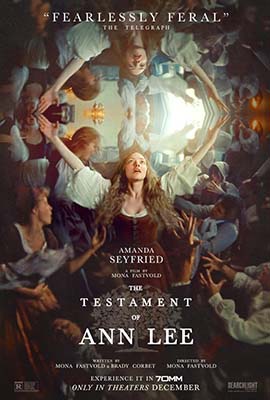 In the titular role, Amanda Seyfried delivers a radiant, remarkable performance in “The Testament of Ann Lee,” although the linear biographical musical lacks emotional resonance.
Intrigued by the 18th century religious leader who founded the Shaker sect and was falsely accused of witchcraft and treason, filmmaker Mona Fastvold chronicles the rise and fall of this admittedly remarkable woman.
Narrated by Sister Mary Partington (Thomasin McKenzie), Mother Ann’s ardent acolyte, it begins with Ann’s childhood in Manchester, England, in the mid-1700s. From a young age, she felt the wrath of her strict father and was disgusted by his sexual domination of her mother.
Illiterate yet eager to do God’s holy work on Earth, she attended a revivalist meeting at the home of Jane Wardley (Stacy Martin) and her husband James (Scott Handy). Accompanied by her devoted younger brother William (Lewis Pullman), Ann joined their congregation — and that’s where she met Abraham (Christopher Abbott), a blacksmith whom she married.
After birthing and losing four babies, pious Ann became convinced that all “fornication” — including between married couples — was not only a tool to subjugate women but also proof of a person’s alienation from God.
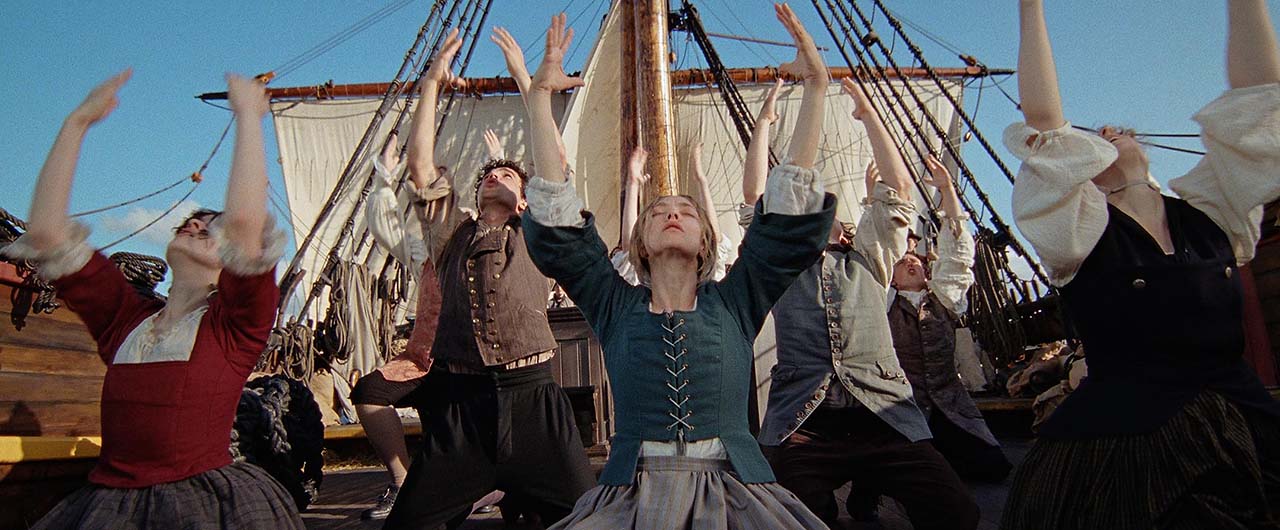
So her self-sustaining, communal religious doctrine was founded on stoic principles of lifelong celibacy and radical utopian equality: “God created us all in his image, so he must be both man and woman.”
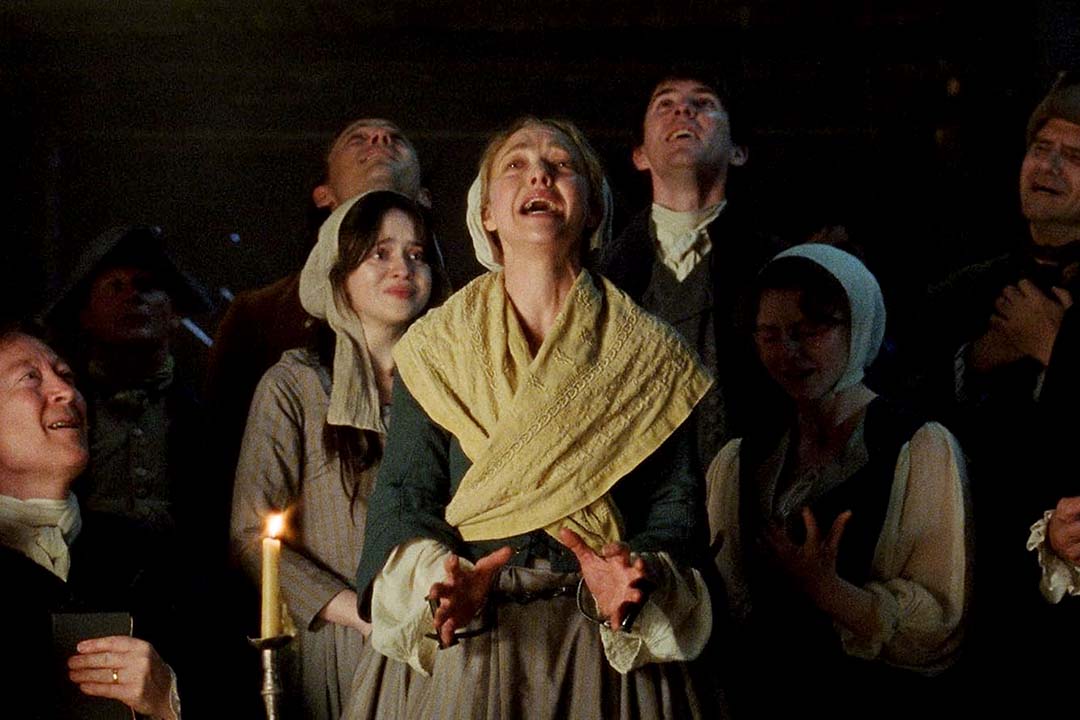
Scripted by Fastvold and her husband Brady Corbet (“The Brutalist’), working with cinematographer William Rexer, it explores and celebrates Ann Lee’s chosen form of worship, incorporating primal singing, orgiastic chanting and cathartic dancing, expelling all temptations and sins, surrendering to the Holy Spirit and then expressing purification joy in trembling exultation.
Adapted by composer Daniel Blumberg from old Shaker spirituals, the music consists of discordant strings, metallic percussion and shrill chorales, accompanying Celia Rowlson-Hall’s stomping, circular choreography.
Meticulously recreated by production designer Samuel Bader outside Budapest, Hungary, the original Shaker colony in Niskayuna, New York, reflected their austere aesthetic philosophy of simplicity and utility in iconic, ladder-back furniture: “A place for everything and everything in its place.”
Proud of her Norwegian heritage, Fastvold notes an obvious similarity to Scandinavian design: “IKEA is heavily influenced by Shakerism.”
On the Granger Gauge of 1 to 10, “The Testament of Ann Lee” is a faith-based, fervent 5, streaming on Netflix, Prime Video and Apple TV.
 Susan Granger is a product of Hollywood. Her natural father, S. Sylvan Simon, was a director and producer at M.G.M. and Columbia Pictures. Her adoptive father, Armand Deutsch, produced movies at M.G.M.
As a child, Susan appeared in movies with Abbott & Costello, Red Skelton, Lucille Ball, Margaret O’Brien, and Lassie. She attended Mills College in California, studying journalism with Pierre Salinger, and graduated from the University of Pennsylvania with highest honors in journalism.