
Lamont on Energy, Healthcare, and More
Weston Today photos
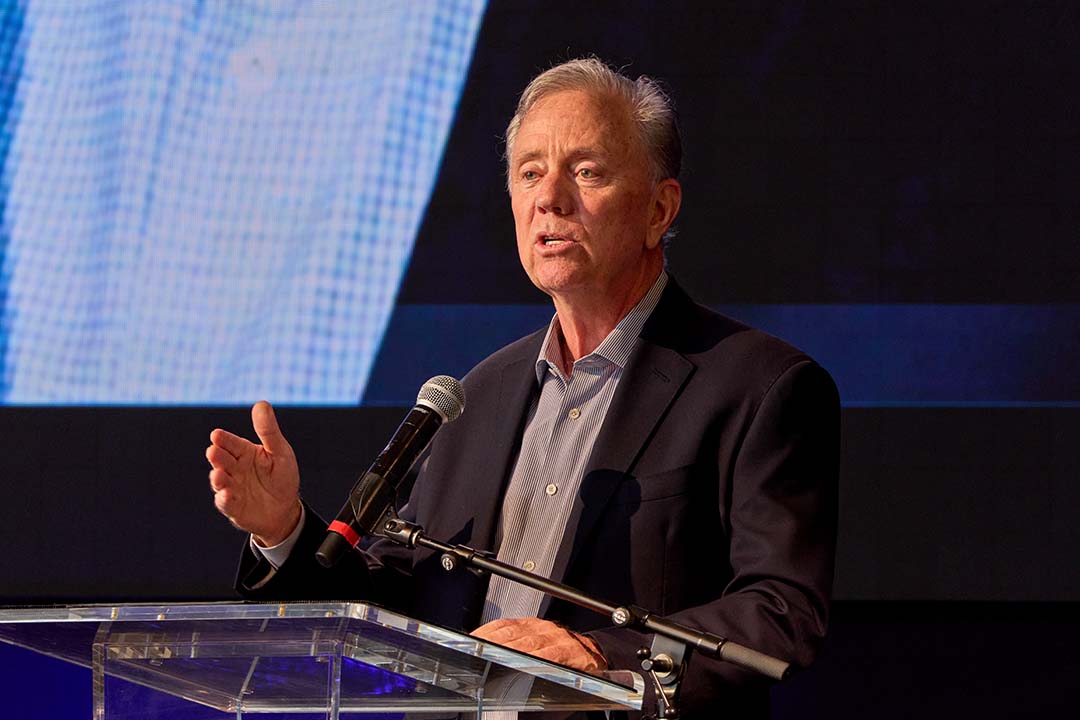
“I like where the state is right now,” said Governor Ned Lamont in a wide-ranging Chamber of Commerce discussion at The Westport Library on April 13.
“We’ve added more new businesses, small businesses, more new startups,” he said. “We are one of the fastest growing states in the country right now. That wasn’t true ten years ago,” when “we went from deficit to deficit to deficit, companies were leaving the state, and young people were all moving to Boston and New York.”
“We’ve tried to change that trajectory.”
Going forward, said Mr. Lamont, “we’ve got to work very hard to make sure we know what the state’s going to look like in ten years, and also make sure it’s a state where our kids can afford to start a family and start a life.”
“Basically, I wouldn’t trade places with most other states right now, but it’s incredibly complicated.”
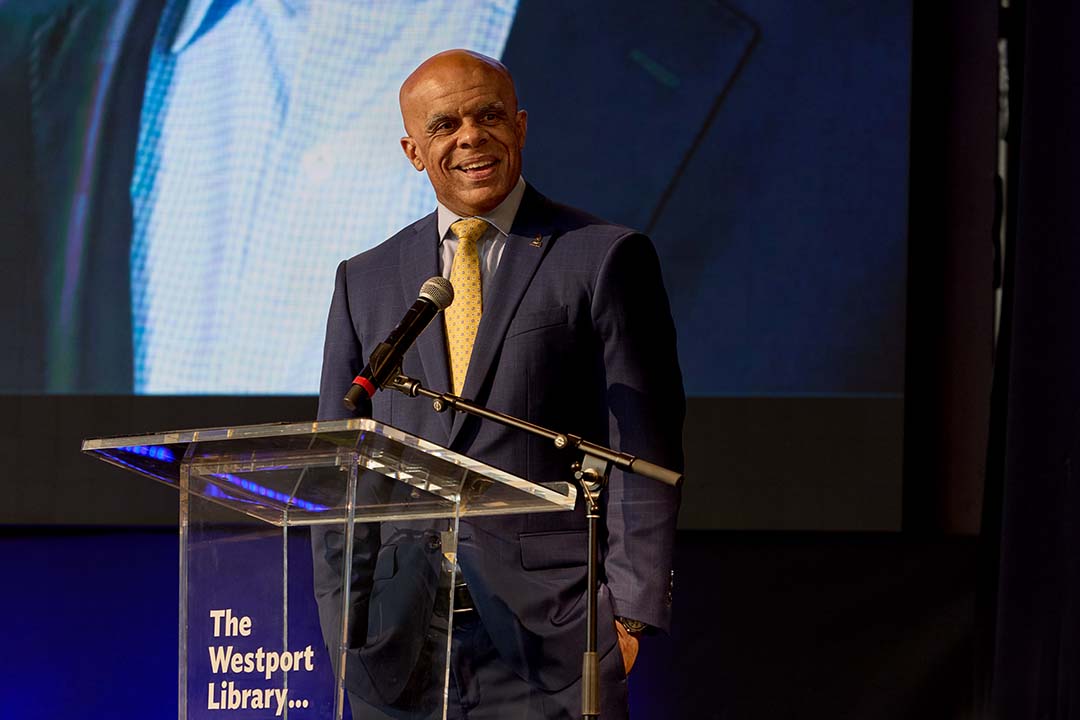
Westport First Selectman Kevin Christie welcomed attendees.
Washington
A complication today, said the governor, is that every week or so, “we get another incoming from the White House.” While during the Covid-19 crisis “we were able to manage by ourselves, this time it’s a little trickier.”
He described “herky-jerky” decisions coming out of Washington on funding for infant formula, healthcare subsidies, and Medicaid. “We were able to step up and backfill” some of that, he said. “But I can’t do this forever. These are big pieces of change.”
“It’s no easier for the business community,” he added. “When tariffs are on, tariffs are off, tariffs are on, businesses invest, they don’t invest, they invest. We need a little ‘steady.’”
Energy
The governor said the “notorious” public benefits charge on electric bills will “go down quite a bit, starting in about three months.”
He said electricity prices in Connecticut have always been high, partly because the state is “at the end of the supply chain” for expensive natural gas and doesn’t have much space for solar power. “Believe it or not, he said, “we’re buying solar power from Maine.”
“So we are looking at alternatives,” he said. “I’d like to see our nuclear power expanded along with solar and wind.”
Mr. Lamont said the Revolution Wind offshore project is beginning to generate power — at about half the price of natural gas — despite White House attempts to cancel it, and that the Millstone nuclear plant provides “almost 50 percent of our power.”
The public benefits charge can come down, he said, because “we’re making a lot of money on the nuclear power trade.” He added that the charge has helped pay for nuclear, solar and wind power, plus energy efficiency programs. It also “pays for people who aren’t able to pay their electric bills,” a component he said will soon be removed from the charge and funded by bonds.
Education
“We’re just getting started on universal, early childhood education,” said the governor.
“We’re going to make it no-cost to all families earning up to about $125,000. We ought to be able to get there for Pre-K by next year.” He said this could save families with one or two children under the age of five $15,000 a year.
“I want this to be the most family friendly state in the country.”
He added that he would work with the Legislature over the next month to examine ways to provide more education funding to relieve school budgets and property taxes.
Healthcare
Governor Lamont said healthcare costs are “probably the biggest problem I’ve got to deal with right now.”
“They’re going up double digits all across the country,” he said. “It’s impacting our budget and our Medicaid budget. And it’s impacting your budget, your school board budget, and small businesses.”
The governor said he disagrees with legislators who “want Connecticut taxpayers to backfill all this. I think we have some of the best insurance companies here. We’re going to create a network that brings down costs, and then have the insurance companies take the risk, not us.”

Taxes
Asked about taxes, and specifically taxation on Social Security, Governor Lamont said: “We cut taxes. I didn’t cut taxes for the highest income people, but we had a $400 million tax cut, the biggest income tax cut in state history, for people earning less than about $200,000. We eliminated the income tax for working families, so we made their tax code much more progressive.”
“We eliminated the income tax on Social Security for everybody earning up to $100,000. We haven’t eliminated it for everybody yet. Every time I eliminate a tax, I’ve got to figure out how to pay the bills a different way. There’s no such thing as free money out there.”
Local issues
Governor Lamont said he had just become aware of controversy surrounding the planned replacement of Westport’s Cribari Bridge, but promised to connect with First Selectman Kevin Christie, State DOT Commissioner Garrett Eucalitto, and “work with you to get it right.”
On the pending sale of Aquarion Water Company, the governor said Attorney General William Tong believes “the numbers are not right,” is “looking at this hard,” and wants the Public Utilities Regulatory Authority (PURA) to “take a second look.”
PURA had originally voted against a plan by Eversource to sell Aquarion to the South Central Connecticut Regional Water Authority (RWA), but reversed itself after a court rejected its reasoning. Legislation pending in the current session of the General Assembly aims to restore PURA oversight of Aquarion if the sale proceeds, but the bill has not yet reached the floor.
The event
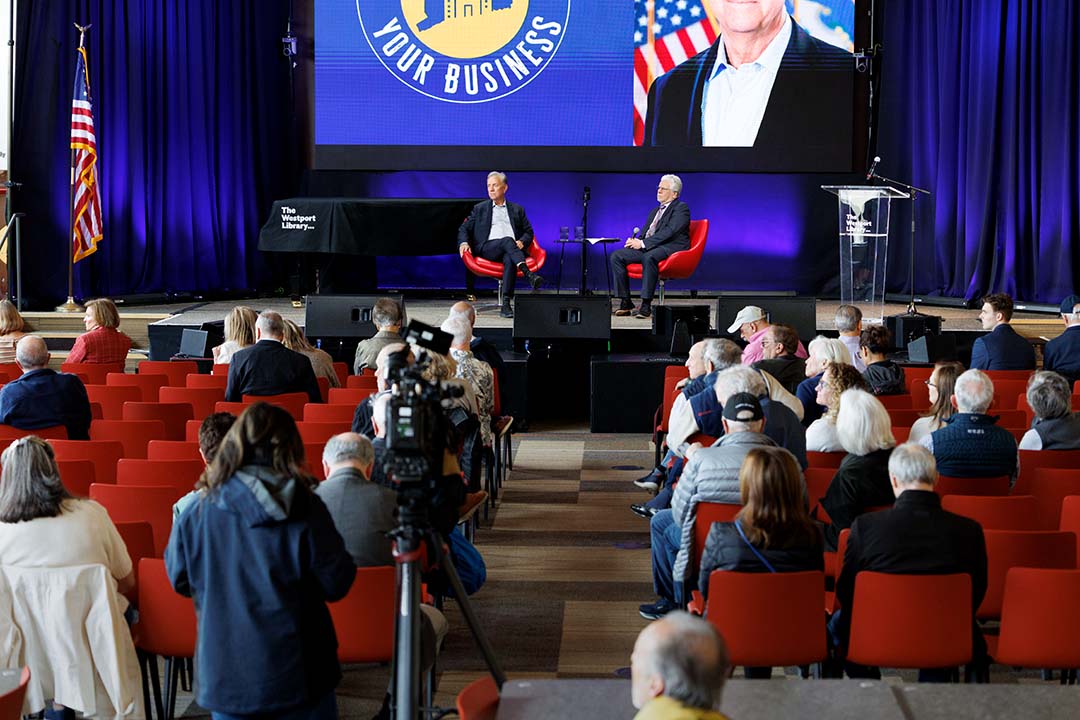
Governor Lamont’s appearance was the fourth in a “Your State, Your Business” speaker series put on by the Westport Weston Chamber of Commerce. Previous speakers were State Comptroller Sean Scanlon, Secretary of the State Stephanie Thomas, and Attorney General William Tong.
First Selectman Kevin Christie welcomed attendees to the event. Matthew Mandell, the Chamber’s executive director and president, introduced the governor and moderated a Q&A session.