
In Focus: Charter Revision
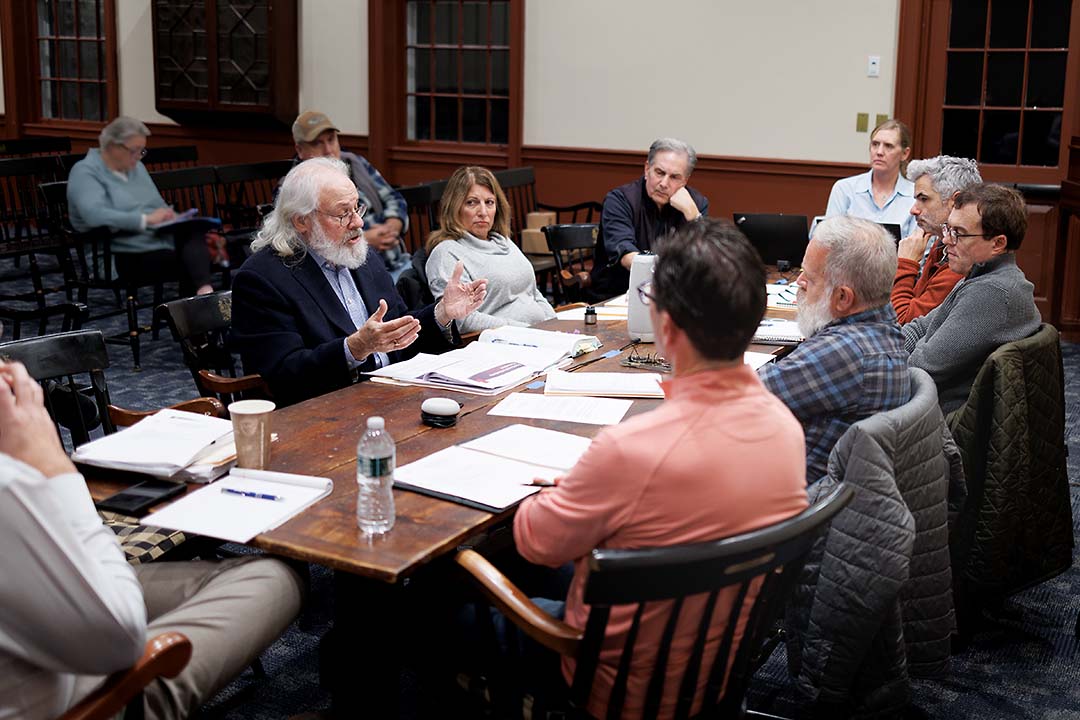
Weston Today photo
Possible changes to the Weston Town Charter, including a new look at the budget process and party representation on Town boards, are the subjects of a public hearing by the Charter Revision Commission on Thursday, April 16 at 7:00 pm in the Town Hall Meeting Room.
The hearing is a required step in the commission’s work before submitting formal recommendations to the Board of Selectmen later this month. Depending on action by the selectmen, proposed Charter revisions could be put on this November’s general election ballot.
Among its assigned tasks, the commission was charged with considering possible changes to the budgeting process, particularly with a view to enhancing public engagement.
The ATBM, and engagement
The commission’s draft recommendations call for changing the Annual Town Budget Meeting to a discussion-only forum, where the public and town officials could have a free back-and-forth on proposed budgets.
Voting on the budgets would proceed as it does now, with machine-counted ballots cast in a townwide referendum, starting that evening and resuming a week or two later.
This would change the current structure and process of the ATBM, where a majority of attendees (assuming the presence of a quorum, 130 voters) can reduce budget allocations but not increase them or fund other items.
The draft also requires the Board of Education to hold a public forum before voting on its budget request. Definitions in the draft clearly distinguish between a public forum — a free-flowing dialogue — and a public hearing, often legally required but where officials are supposed to be in a listen-only mode.
Similarly, the draft would require the Board of Finance to hold one or more hearings before the ATBM, and the first must be a forum-style public dialogue with Town and school district officials on hand, ready to discuss. It would start with a budget presentation by the first selectperson.
Party representation
Currently, the Weston Town Charter limits to a bare majority the number of members who can belong to the same political party. The Connecticut statute is somewhat more permissive, and the commission’s draft recommends following State law.
For example, under State law a seven-member board or commission (the number on most Weston major boards) would be allowed to have up to five members from one political party, but no more. Weston’s current Charter limits the majority to four.
The argument is that, especially when there is a wide disparity in the town’s party affiliations — as there is in Weston at the moment — the current bare-majority rule forces an over-representation on Town boards by a minority party and under-represents the majority party.
Currently in Weston, there are a few dozen more Unaffiliated voters than Democrats, but Democrats outnumber Republicans by more than two to one.
Ethics
Over the course of its work since last fall, the Charter Revision Commission devoted a considerable amount of time to provisions regarding the Town’s Board of Ethics and handling complaints.
 The commission has been assisted on this and all matters by Attorney Steven Mednick, one of Connecticut’s most experienced municipal attorneys, who has counseled dozens of charter revisions in the state.
The commission’s draft recommends that the Board of Ethics comprise five members and have no party in the majority. No member could hold any other Town office, and all would be required to complete training.
The board would have the power to investigate ethics complaints and determine if a violation has occurred. It would have the power to subpoena, after receiving advice from the Town Attorney or outside counsel, assuming such power is included in an ordinance the selectmen are required to enact within six months from the new Charter’s effective date.
Attorney Mednick warned the commission that ethics complaints have become a new vehicle for harassment of public officials, much as FOIA complaints have been in the past. The draft Charter stipulates that complaints cannot be lodged anonymously, are confidential at least until the ethics board finds probable cause to investigate, and that the subject of a complaint is entitled to be notified and heard.
Other matters
The Charter Revision Commission was assigned to consider whether adjustments should be made to the size of Town boards. Its draft report contains two recommendations: reducing the size of the Police Commission from seven members to five and adding three alternates to the Commission for the Arts.
The draft also addresses what may be ambiguity between existing Charter provisions and the Town’s longstanding procedures for intra and inter-departmental budget transfers during a fiscal year, specifying when and when not prior Board of Finance approval is required.
The commission’s draft also recommends that a Charter review be conducted at least every ten years, and generally cleans up language that is out of date, inconsistent, or no longer relevant.